Curatorial training
Art writer & curator — Brooklyn, NY
Art writer and curator
by training, observant
and curious by nature.
Selected work
Mapping Otherwise
View projectAn imaginary meeting of Zarina and Naiza Khan along Land, Ocean, and Sky—probing the 1947 Partition through cartography, embodiment, and border poetics.
About
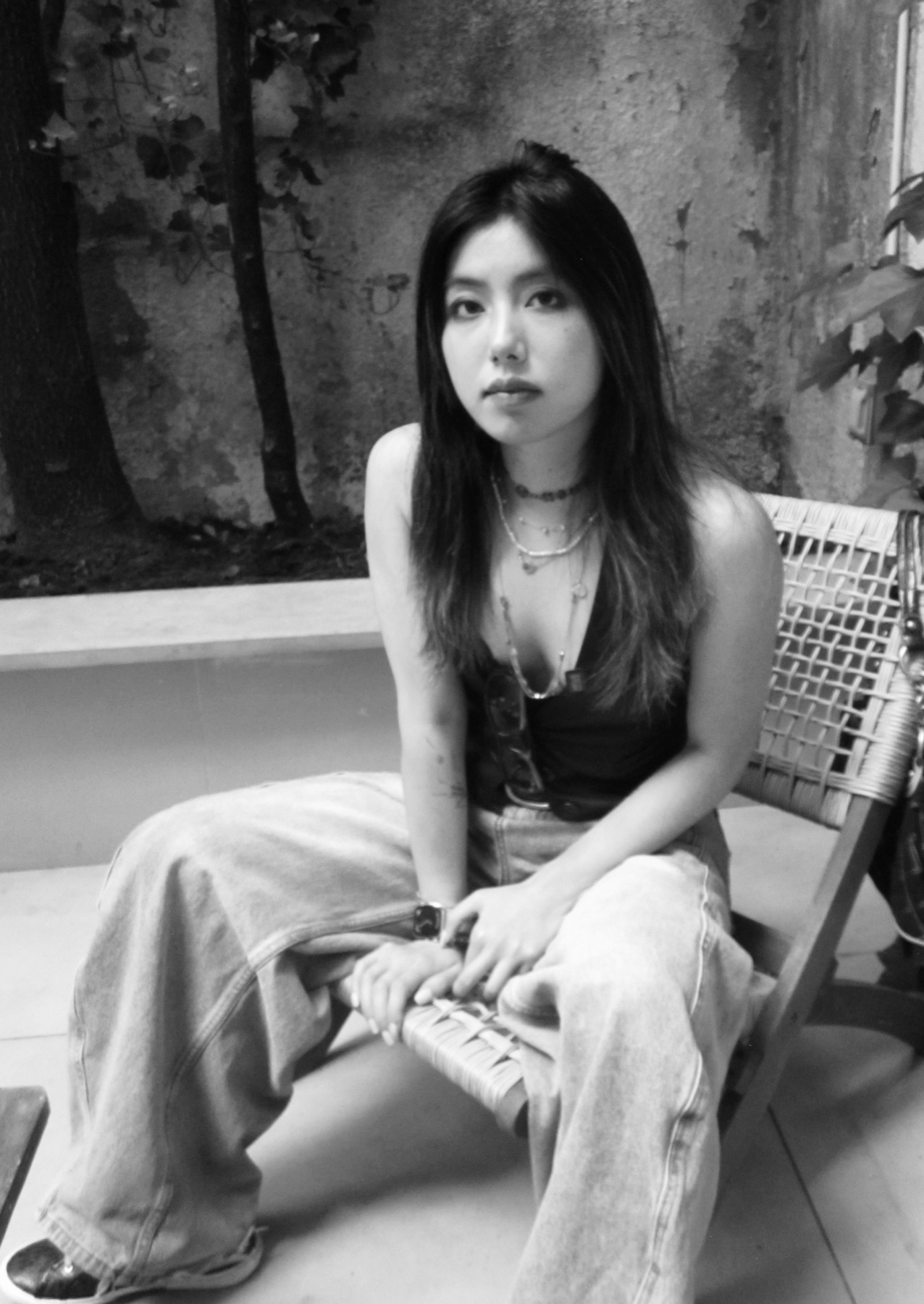
Katherine Duxiaole Zhang (b. Nanjing, China; 2001) is a writer, art historian and curator currently based in Brooklyn, New York. Before coming to New York for her graduate degree in Modern Art and Curatorial Studies at Columbia University, she received her BA in Art History from the Courtauld Institute of Art in London.
Katherine's own life trajectory of having moved across the globe shows its presence in her work — it propels her to envisage the world as interconnected and entangled, historically and geographically. Her current thinking revolves around the political efficacy of sensorial objects, particularly their mediatory function upon consciousness.
Work
Exhibition
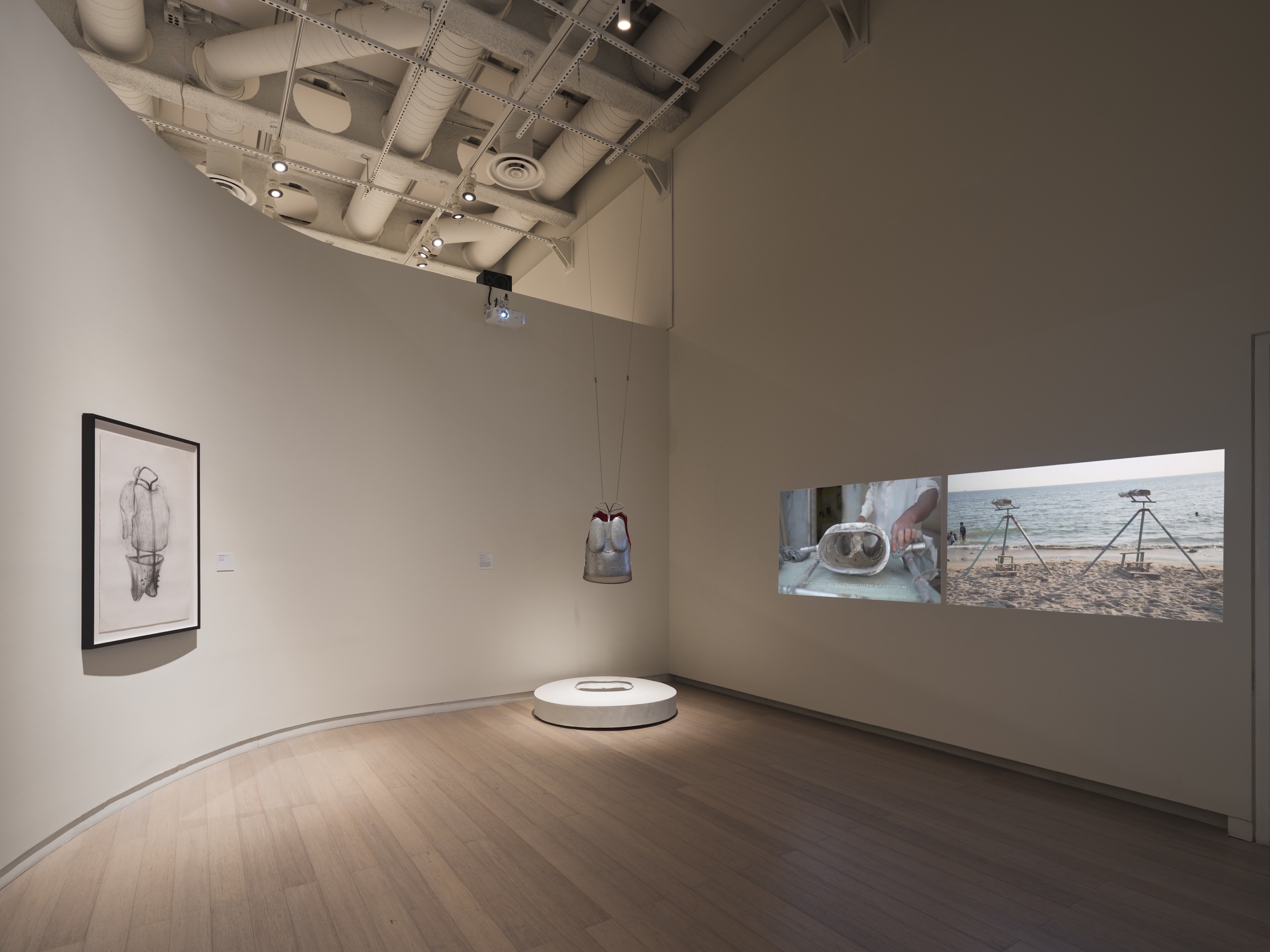
March 28 – April 12, 2026 · Wallach Art Gallery, Columbia University
Mapping Otherwise
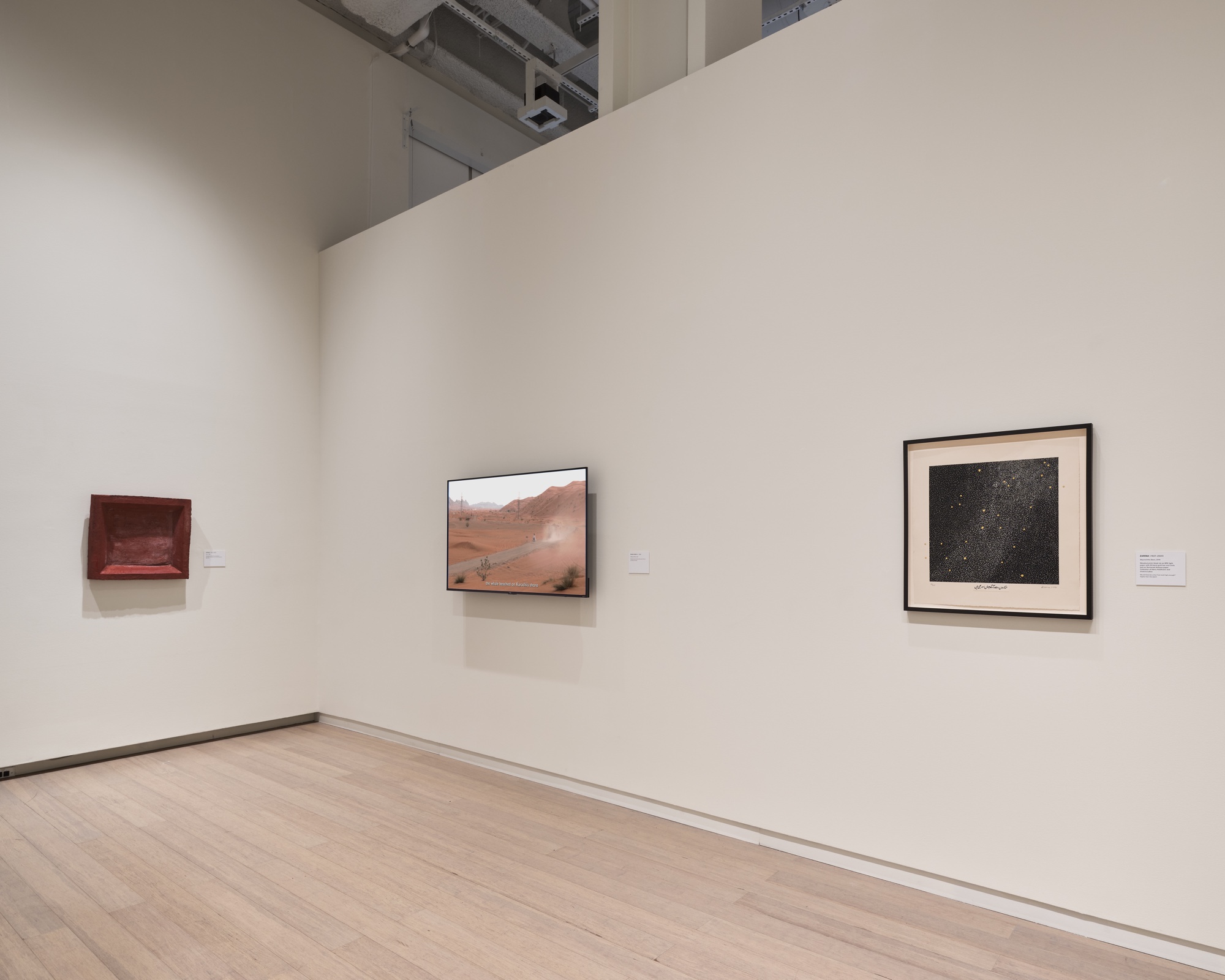
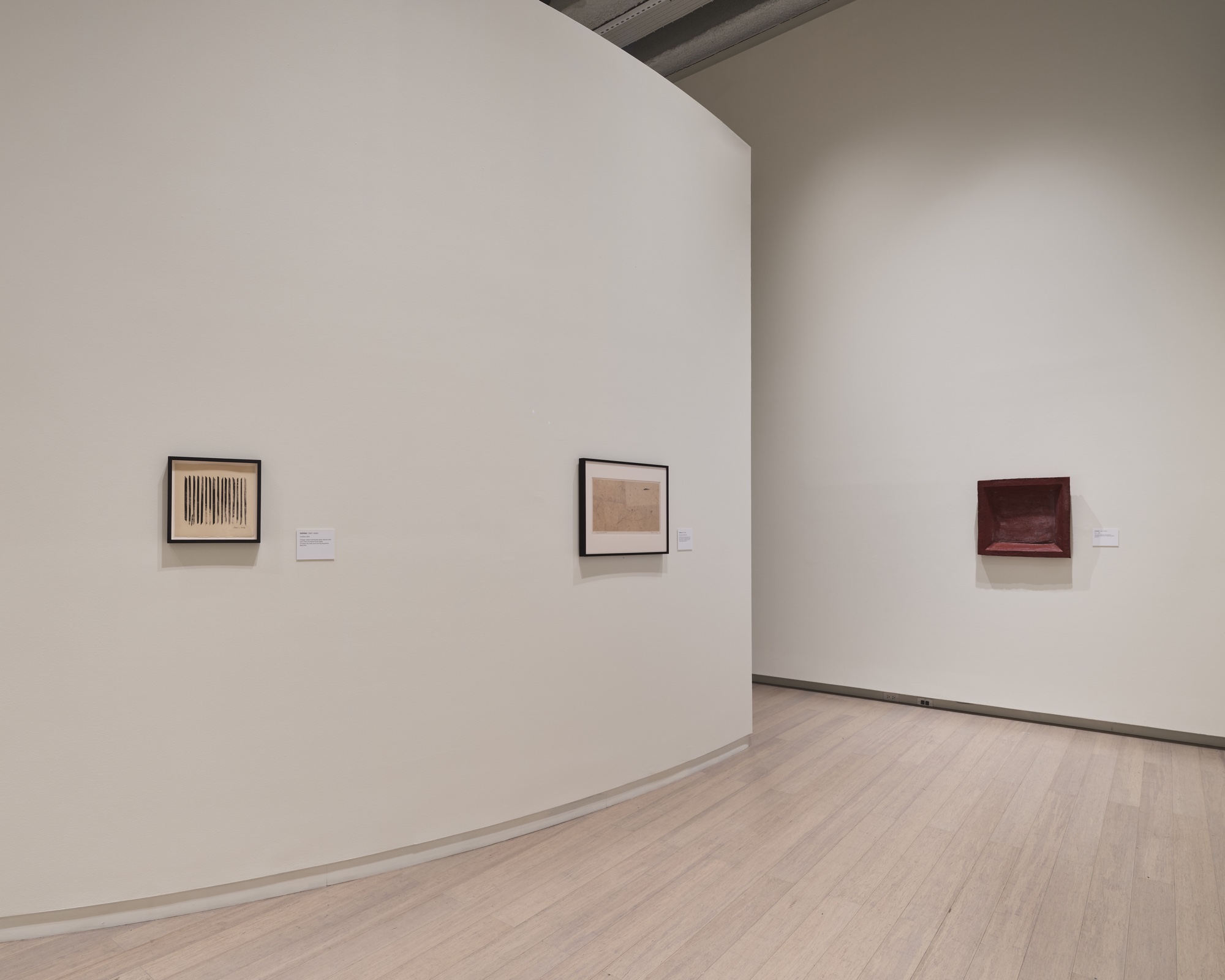
Mapping Otherwise was presented March 28–April 12, 2026 at the Wallach Art Gallery, Columbia University, as part of MODA Curates 2026.
Art has always been political.
Panel Discussion
Another Chance Encounter?
Thoughts can potentially emerge from unexpected places: dreams, sights, rhythms, conversations. In the spirit of the unexpected, this discussion considered the works of Zarina and Naiza Khan and the role of chance that is central to the exhibition, Mapping Otherwise.
Writing
Curatorial essay
Mapping Otherwise
Exhibition catalogue essay published by Wallach Art Gallery, Columbia University, 2026.
Art writing Curatorial essayCritical review
“A Home Is…”
Via the work of artist Yshao Lin, this article considers how the infinitesimally personal and intimate often complement, and at times complete, the broader sweep of collective history.
Art writing Critical reviewTraining
Curatorial training
Alexis Gregory Curatorial Practice Program
Education
MA, Modern Art & Curatorial Studies
Columbia University, New York
Education
BA, History of Art
Courtauld Institute of Art, London
Curatorial essay
Mapping Otherwise
Exhibition catalogue essay published by Wallach Art Gallery, Columbia University, 2026.
How is a cartographical line a wound? When does the wound heal and its scar fade? Or do they ever?
One could argue that we do not need to reassert that borders are fictional, given the abundance of such lines of argument.1 A border born out of a partition, for instance, has often been theorized as a conceptual line artificially engraved onto previously undivided land.2 Arguments against borders resonate widely among those who already embrace them, but are easily silenced by those in positions of power, who eagerly stabilize, if not expand, the boundaries of modern nation-states.
Yet, if borders are fictional, why is pain from their construction so profoundly felt? Artist Zarina Hashmi (b. 1937, Aligarh, British India; d. 2020, London, UK), who preferred to use only her first name professionally, repeatedly called the 1947 Partition lines that divided the Indian subcontinent into the two new nation-states of India and Pakistan “line[s] etched on her heart.”3 Naiza Khan (b. 1968, Bahawalpur, Pakistan) came to know Zarina and her work through a chance encounter with her prints. Printmaking, the inherently democratic and translational medium, allows for reinscription, repetition, and the creation of many from one. The two artists, generations apart, share the same identity as post-partition subjects, along with many others, before and after them.
Mapping Otherwise offers an imaginary meeting of the two artists who were once apart temporally, geographically, and geopolitically, but with this exhibition, are no longer. The exhibition is structured along a vertical cosmology—Land, Ocean, Sky—that mirrors the movement from grounded pain to fluid relation and finally to reconciling and liberating transcendence. In meteorological imagination, the artworks converse across land, ocean, and sky—the very elements through which the world itself is drawn, and therefore, the very elements that can redraw the world.
In her influential book The Long Partition and the Making of Modern South Asia (2007), historian Vazira Fazila-Yacoobali Zamindar urges us to reconsider the Partition of India in 1947 not as a singular historical event, but as a prolonged and ongoing process—a long durée whose reverberations continue to shape the subcontinent today.4 Partition, she argues, did not neatly usher in the sovereign states of India and Pakistan; rather, it initiated a protracted and violent reordering of boundaries, identities, and memories that remains unresolved.5 In the wake of renewed conflict between India and Pakistan in May 2025—when the Indus Water Treaty was suspended, and military action resumed in Kashmir—Zamindar’s argument feels especially prescient. The partition’s legacy has once again erupted into public consciousness, proving its ongoing capacity to disrupt lives, ignite conflict, and reopen historical wounds.
Business as usual no longer works in the face of such an explicit reactivation of historical rupture; deal with it, the 2025 event demands. The artworks in this exhibition offer no solution to the partition’s long afterlife, but they do aim to soften the antagonism and encourage their audience to ask: How have we come to this, and do we have to stay here? The earliest artwork in this exhibition was made in 1991 (Zarina, Crawling House), and the most recent one in 2023 (Naiza Khan, Mapping Water). Zarina’s small sculpture is of one, barely discernible house equipped with two wheels, looking for its direction towards a place to call home unaccompanied; Naiza Khan’s film 32 years later shows the former’s quest no longer unaccompanied. Geographically expansive, Mapping Water reminds us that mapping otherwise should be, and has been, a collective effort.
The wound of the 1947 Partition lies at the conceptual core of Zarina’s practice. Starting the exhibition, her Dividing Line (2001) renders this history visible through a single incision: a thick black mark pressed into handmade paper, the blackness absorbing all light and denying visual access. Zarina called sumi ink “transformative,” for it swallows the surface it touches. For an artist displaced at ten years old from her home in Aligarh to refugee camps in Delhi and Karachi, the border is not an abstraction; it is a site of pain, a swallowing void, a permanent incision between memory and belonging.6 “Families were split, homes destroyed, the fabric of life permanently altered—all for this new border, this dividing line,” she wrote decades later.7
In Dividing Line, the act of mapping becomes inseparable from the act of wounding. For Zarina, paper is “like skin—you can scratch it, mold it, it even ages.”8 The borderline, then, is not merely cartographic but also corporeal. Each cut is a gesture of embodiment and an act of wounding. The thick dividing line trembles, bulges outward, screaming its discontent, recalling a fresh wound still swollen and too painful to be touched.
The abundance of corporeal metaphors in border studies is not coincidental, and Anthropologist-Geographer Franck Billé’s recent book Somatic States: On Cartography, Geobodies, Bodily Integrity (2025) investigates precisely such a phenomenon.9 Poetic as they are, these corporeal metaphors’ efficacy reaches far beyond the provision of pleasure in their reading.10 They raise the stakes of border conflicts for those politically and geographically far removed.
The body—the vessel that each being occupies—might give us a place to ground our thinking. Naiza Khan’s armor series makes explicit Zarina’s subtle gesture towards embodiment in her maps. To imagine one’s body dressed in Khan’s armor is to imagine the body contained, confined, but also protected. Steel covers flesh, replaces skin, conceals vulnerability, and denies injury—there would not be another chance to scar. The armor delineates the threshold of the body and marks a resolute material departure from the tender softness of skin. In a 2007 series of photographs titled On the Frontline, Khan’s armors are placed along the shore, sitting in the ebb and flow of the sea. “Frontline” implies a battle but does not specify whose. The empty armors seem to be waiting for their wearer, for someone to set foot into the sea, to join the frontline—that person could be you, could be me.
On the Frontline captures a moment when Khan relinquishes the protective force of her armors to oceanic fluidity. The moment coincides with a shift in her thinking from embodiment in its more literal sense to embodied landscapes.11 Where Zarina’s lines solidify the wound, Naiza Khan’s maps liquefy it. In Khan’s film Mapping Water (2023), the artist pours watercolor paint using seashells, translating colonial histories of trade, migration, and empire into an aqueous visual language. The sea, for Khan, is not an empty expanse but a site dense with memory. As she notes in her narration, “This land is marked by the legacy of colonial infrastructures—dams, canal systems, harbor expansions—the division of land against the land itself.”12 The ocean, in contrast, becomes her space of continuity and re-connection.
If Zarina’s map absorbs light, Khan’s refracts it. The two artists form an elemental pair: earth and water, opacity and transparency, fixity and flow. Both engage mapping, not as a practice of mastery, but as a poetics of relation—an archipelagic imagination that redefines geography through movement—where, to borrow a Glissantian phrase, every point connects not through dominance but through fluid interdependence.
Zarina’s late work Beyond the Stars (2014), turns our eyes upward, guiding them towards a gentle celestial order that has drifted into alignment. The cosmic becomes a site of reconciliation. The sky, long used for surveillance and mapping—through triangulation, aviation, and satellites—here becomes a space of repair. Zarina’s gaze refuses the colonial verticality of control; her heavens are intimate, fragile, and personal. Gold foil gleams like the faint promise of continuity, connecting the celestial with the earthly scar below. If Mapping Water renders the ocean a site of submerged histories, Zarina’s sky imagines the possibility of emergence—a lifting of the gaze that does not erase the wound but carries it into the light.
The soundtrack of Khan’s Mapping Water reverberates through the space like a weather report—ambient, borderless weather that disregards national divides. To map otherwise is to embrace the amorphous nature of place, to acknowledge that every border is both scar and bridge. Yet it does not mean that “borderlessness,” however ideal that might sound, is desirable in every case. Sticky Rice and Other Stories (2019) demystifies utopian globalism by provoking considerations of power structures underlying networks of trade, aid, sovereignty, and reliance. The film is set in Pakistan’s coasts, yet finds itself pondering over China. It sits at the crossroads of colonial and capitalist forms of extraction and urges us not to lose sight of coloniality in considerations and assessments of modern nation-states with neo-imperialist ambitions.
The show begins and ends with Zarina’s borderline, looping temporality into a circle rather than a sequence. Twelve years after Dividing Line, Abyss (2013) returns to the dividing line that distinguishes the same landmass in Zarina’s earlier work, but now carves directly into it. Where Dividing Line rendered the scar, Abyss opens the wound. The artist’s chisel reopens what history tried to close, but this incision is no longer purely painful. It is, paradoxically, an act of repair. The paired works mirror and complete one another. One image is left blank with the exception of one thin line, the other is printed completely black with the exception of one untouched line; should the viewer imagine them visually superimposed, they complete each other.
The two artists, Zarina and Naiza, were once so close to meeting and—as I am sure they would have—having a lovely conversation, in person. Zarina moved to London in her final years, where Naiza Khan also lives, yet the two never met. “Had I known she was in Wimbledon,” Khan once said, “I would have gone to visit.”13 Mapping Otherwise offers the imaginary meeting, not as lost, but as deferred: a convergence across time and that 1947 border line. Between Zarina’s ink-dark line and Khan’s fluid sea, a new geography takes shape—one that refuses the violence of enclosure and gestures, instead, toward connection in a larger temporality.
Critical review
“A Home Is…”
May 2026.
Rose is a rose is a rose is a rose.1
Such is the well-known line from American poet and playwright Gertrude Stein’s 1931 poem Sacred Emily. The author later explained: “When I said. ‘A rose is a rose is a rose is a rose.’ And then later made that into a ring I made poetry, and what did I do? I caressed, completely caressed and addressed a noun.”2
The caressing was achieved through repetition, through going back to the same word, uttering the same sound—each time with a different tone perhaps—hearing its sound, its echo, making it at once the most familiar and the most strange. Stein gave Rose (the first Rose is a name and a person) full attention, with each repeated rose, the word refers to an earlier iteration of itself in a marvelous act of mise en abyme.
With each utterance of rose, the reader’s voice cannot help but soften, as if encountered with the author’s tender gaze. This act of repetition—the constant moving back, recalling and revisiting—finds itself in the works of many others, among which is Yshao Lin, a young artist who is now writing his story in the very city Stein, too, lived in.
Lin comes from an island called Hujiang (壶江), located in the province of Fujian, adjacent to the southern border of Mainland China. The artist grew up in this town, historically a fishing community, surrounded by seafaring tales brought home by adults who departed and returned. In Lin’s film As I Wonder, As I Dream of It, Lin, as someone who grew into an artist and now holds the skill of constructing visuality, finally materialized the countless tales that composed his childhood.3 With its mesmerizing sonic texture that synthesizes the unlikely pairing of both birdsong and sounds from the bottom of the sea, As I Wonder’s dream-like seascape invites its viewers into the most intimate of Lin’s memories—a fantasy the artist constructed, once for himself alone.
He tailors the scene with an openness for collective viewing, for Lin’s story was his, but also that of many others. As Yshao Lin recounted, those from his hometown, Hujiang, shared strikingly similar migration trajectories, or as he put it, “My story is no different from the others from my hometown.”4 Migration from coastal rural China, of which Fujian is exemplary, to the United States since the latter half of the twentieth century is by no means a new area of research.5 As sociologists Zai Liang and Miao David Chunyu have noted, the dramatic increase in international migration from Fujian to the USA and Europe, particularly after the late 1970s, has commanded critical attention for quite some time.6
By employing the network theory of migration, Liang and Chunyu uncover the communitarian dynamism within the international migration of Fujian. Such migration tends to work as a chain reaction depending on the link between those who settled into their destination and those who are potential migrants from the migrant-sending communities.7 In the words of our artist, “It all started with one family member, then another, and eventually the entire village emigrated to other countries and left babies and the elders behind.”8
Indeed, as Yshao Lin reminds us, “babies and the elders” have often been excluded from this network, at least at its initial stage, and instead tasked with the job of staying behind.9 For Lin, in his own lucid recounting, “My parents left me to my grandparents when I was five years old, and followed every other young person’s footsteps to the United States to seek better lives. I reunited with my parents when I was fourteen.”10 Repeatedly, Lin emphasizes that his story is not unique. In a Master’s thesis titled “From the Lucky Land to the Beautiful Country,” the author Miao Lin included the words of a child, who, similar to the artist, watched his father compose part of the Fujianese migratory network: “When my father left, I was twelve. I felt sad for his leaving because he was such a good father. I did not know exactly where he was going. I was told he would travel far away from home to make money. After he earned money, we could live a better life.”11
When They Ring Those Golden Bells is an early series within Yshao Lin’s body of work. When speaking of the series, even the maker’s own memory took time to be activated. The faded colors of the photographic series mirror the artist’s effort in excavating this memory of a place and time that now feels quite distant. As the artist ventures into new areas of inquiry concerning gender, sexuality, and masculinity, home no longer features explicitly in the artist’s more recent works, although it arguably never faded away. Perhaps under the sweeping romanticizing force that sometimes comes with time, traces of the past—of a once-intimate place and a childhood spent in waiting—now seem tender yet blurry. These memories excavated from fringe consciousness—the aftertaste from a once all-too-clear time—are revisited, recalled, and reassured.
I am not interested in victimizing the artist, or the countless others who waited as their caretakers left home in search of a better life, nor do I wish to vilify the parents who left their families in search of a better life—such is a noble pursuit. Time, I would argue, is the unnamed protagonist in When They Ring Those Golden Bells. Burning incense, drying shrimps, gathering dust, time was (and is) flowing and passing, eternally present. In the words of T. S. Eliot, “Time present and time past / Are both perhaps present in time future, / And time future contained in time past.”12 Time’s eternal presence, perhaps, can be found in its aftertaste.
Lin’s photographic series complements broader, largely quantitative research in migration studies with a piece of personal archive. Amidst ongoing conversations questioning the truth scheme of “History” with a capital H—that is, a narrative (often consciously) mediated by uneven discursive, political, economic, and social power structures yet misleadingly presented as a neutral mainstream—a micro-historical approach that takes seriously previously overlooked pieces of evidence has gained significantly more traction in the past few decades.13 Following the methodological shift, the practice of history writing has indeed seen its decolonial reflection, and increasingly recognizes forms of documentation, such as oral history traditions, that have been established and valued beyond the post-Enlightenment Global North.
However, it is worth noting that such a shift towards historically dismissible—and indeed dismissed—micro-narratives should not be understood as a blind endorsement of a multiplicity of what are often called personal truths. While the turn toward personal truths disrupts History’s fixation on macro narratives, it risks losing itself in the other extreme: absolute relativism, which could potentially negate attempts at a narrative that hopes to account for more than one individual.
The story animating Yshao Lin’s When They Ring Those Golden Bells belongs to him, yet accommodates many more. Lin’s story resonates beyond his island, his country, his language, his generation… Revisiting the story today, amidst renewed discussions of the (il)legality and criminalization of migration, it will matter for many more years to come.
A home is a home is a home.
Exhibition — Curator
Mapping Otherwise
How is a cartographical line a wound? When does the wound heal and its scar fade? Or do they ever?
Mapping Otherwise hosts an imaginary meeting of two artists who were once apart temporally, geographically, and geopolitically, but with this exhibition, are no longer. Through the work of Zarina Hashmi (b. 1937, Aligarh, British India; d. 2020, London), who used only her first name professionally, and Naiza Khan (b. 1968, Bahawalpur, Pakistan), the exhibition asks why borders, if products of fiction, produce such profoundly felt pain.
This exhibition revisits the 1947 Partition to explore the “line etched on the heart,” a phrase used by the late Zarina to describe the violent engraving of a border onto an undivided landscape.
From woodblock print to digital film, both artists reclaim cartography from the state, transforming it into a language of personal and collective memory. The artists raise the question: Are there other spaces of existence beyond what has been officially sanctioned?
The exhibition is structured along a vertical cosmology—Land, Ocean, Sky—that mirrors the movement from grounded pain to fluid relation and finally to reconciling and liberating transcendence. The artworks converse across the three meteorological registers through which the world itself is drawn, and therefore, the very elements that can redraw the world. In doing so, the show asks if there can be a shareable path that persists despite the lines drawn between us.
Presented as part of MODA Curates 2026 at the Miriam and Ira D. Wallach Art Gallery, an annual opportunity for outstanding curatorial proposals related to students’ theses in Columbia’s MA in Modern and Contemporary Art: Critical and Curatorial Studies program.
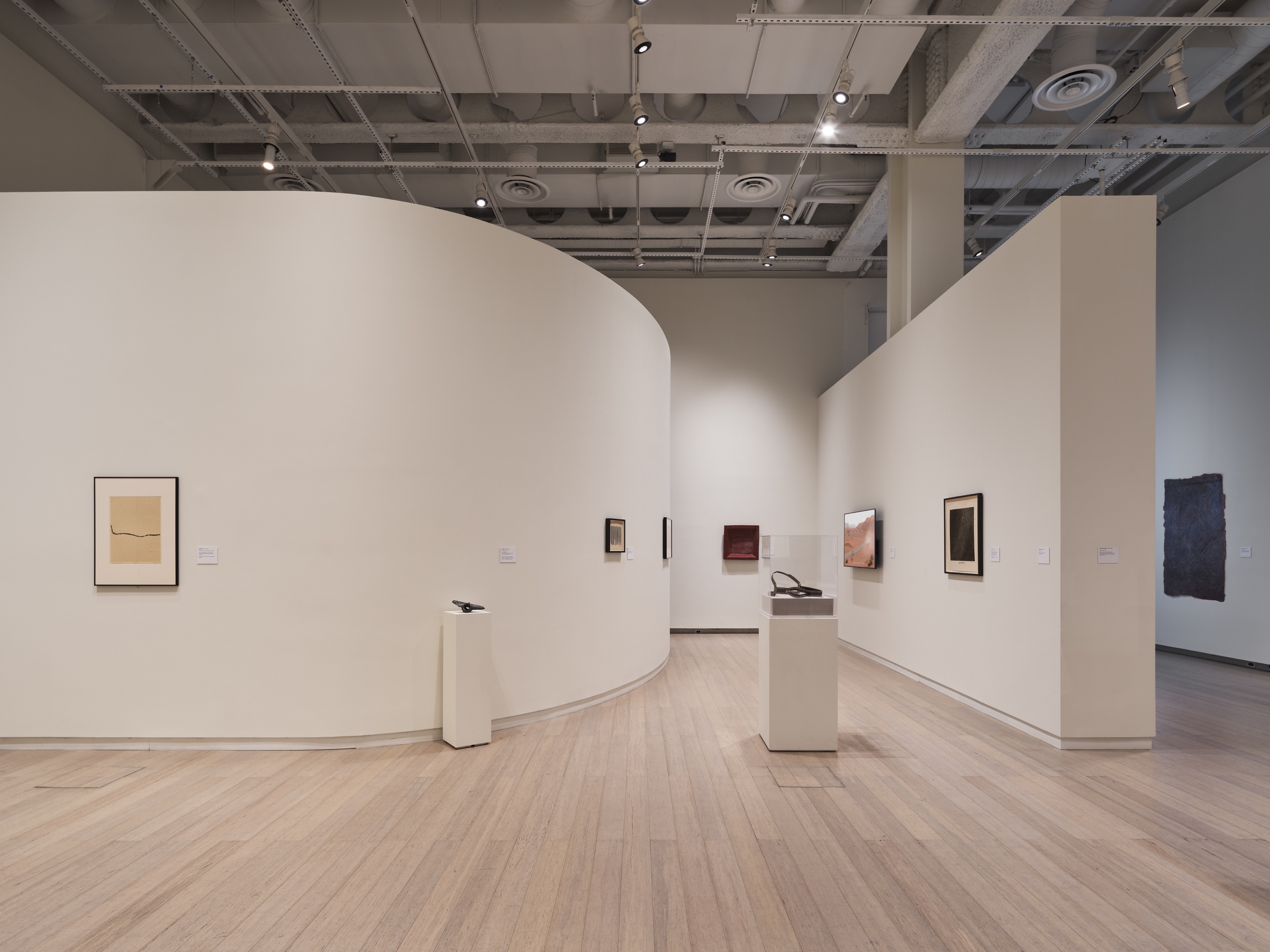
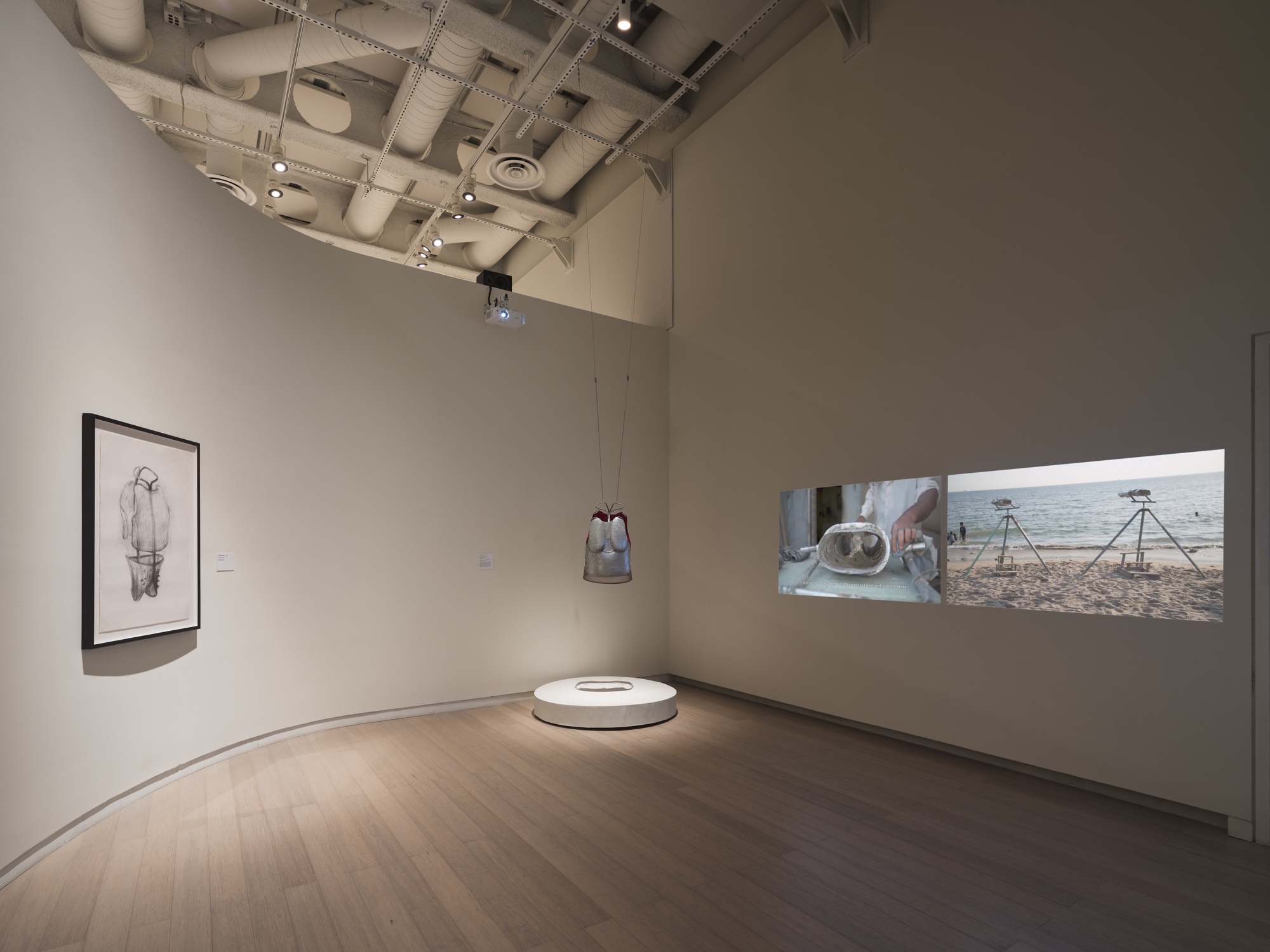
Installation views
Exhibition brochure
Opening remark
Contact
Feel free to get in touch about writing, curatorial projects, or collaborations.
- zhangdu.katherine@gmail.com
- Brooklyn, New York
- @zhangdudou
- @卡卡卡卡住了